
Best Wallpaper for Your House Style: A Dallas-Fort Worth Guide

Match the wallpaper to your home's architecture in three ways: the pattern family (what looks right for the era), the scale and color (what suits the rooms and light), and the material (what the walls can actually hold). In Dallas-Fort Worth that means Tudor Revival homes in Lakewood and the M Streets suit richly patterned florals and damasks, Craftsman and Prairie homes in Oak Cliff and Fairmount suit simpler nature-drawn botanicals, Spanish and Mediterranean homes suit plaster-effect textures and tile-inspired designs, and mid-century homes in Preston Hollow suit geometrics and organic shapes. The older the house, the more the wall condition decides what's possible.
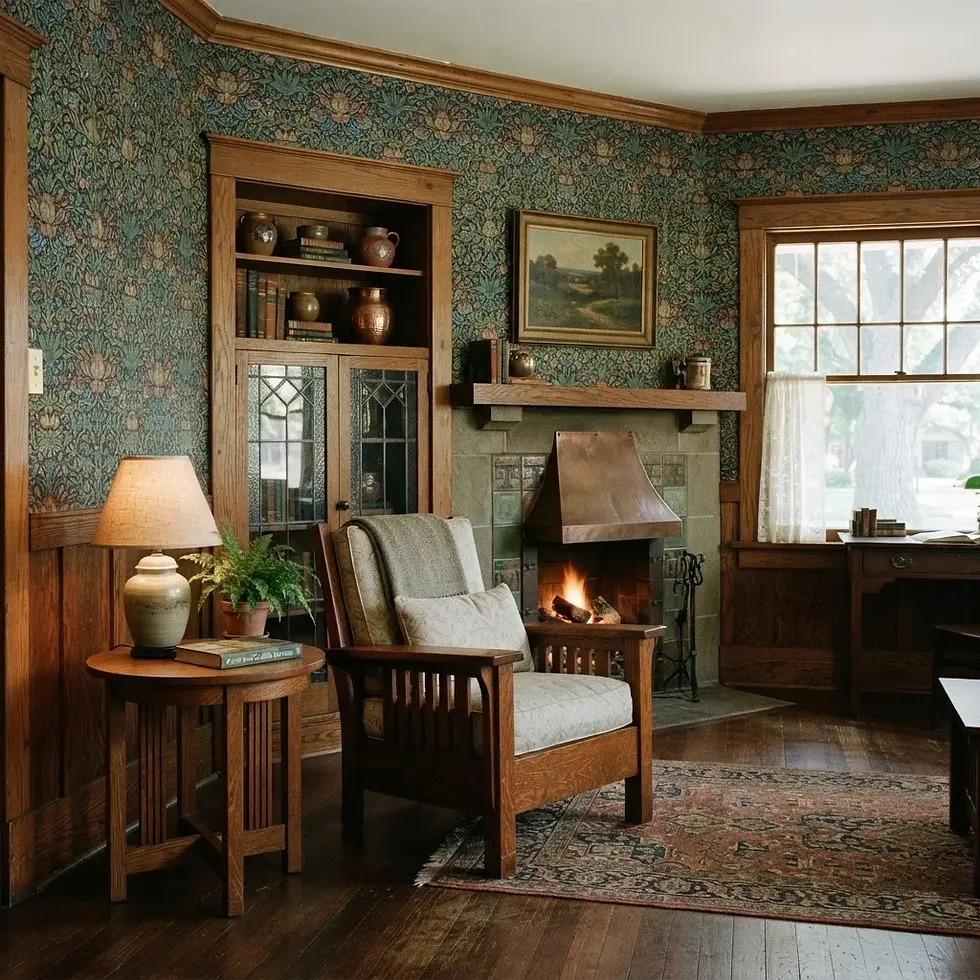
Dallas-Fort Worth is unusually varied. Within a few miles you can go from a 1920s Tudor cottage to a mid-century ranch to a Mediterranean estate to a brand-new transitional home in a North Texas suburb. Wallpaper that sings in one can fight the architecture in another.
This guide covers seven common DFW house styles: where you'll find each, which wallpaper families tend to suit it, and, because the walls matter as much as the pattern, what to check before you hang anything. It's design guidance, not a set of rules. Contrast is a valid choice, and we point out where it works.
How to Read Your Home Before Choosing a Pattern
Three quick checks before you pick wallpaper:
Identify the style and era. Look at the roofline, windows, trim, ceilings, and original details. Homes built between the 1920s and 1940s in Dallas and Fort Worth tend toward revival styles such as Tudor, Spanish Eclectic, and Colonial, while 1950s and 1960s homes lean toward ranch and mid-century forms.
Decide how literal you want to be. Period-accurate reproduction, wallpaper "in the spirit" of the style, and deliberate contrast are all legitimate. A modern graphic wall in a 1920s bungalow can look intentional or jarring depending on restraint and placement.
Check the walls. Older homes often have plaster, textured finishes, or layers of old paint and wallpaper, and the wall condition shapes which materials and designs will work. Our plaster wall guide explains why.
Where DFW's House Styles Live
Local sources describe a clear geography:
Tudor Revival: Greenland Hills, the M Streets in Dallas, is closely tied to Tudor Revival. According to the neighborhood association, more than 65% of its homes were Tudor Revival when its conservation district was proposed. Tudor homes also appear across Lakewood and in North Oak Cliff.
Craftsman, Prairie, and Bungalow: Munger Place and Swiss Avenue include Prairie and Four Square homes, Junius Heights and Swiss Avenue include Craftsman and bungalow homes, and North Cliff has Craftsman bungalows and Tudor cottages. In Fort Worth, local guides describe Fairmount's historic homes as predominantly Craftsman and bungalow, with many English or Tudor-style houses.
Spanish and Mediterranean: Lakewood's mix includes Spanish Eclectic and Mediterranean homes, and Highland Park, Preston Hollow, and North Dallas feature Spanish Revival and Mediterranean estates.
Georgian, Colonial, and Traditional: Highland Park and Preston Hollow have Georgian and Italian Renaissance homes, and Plano and Richardson have many traditional and colonial custom homes.
Mid-century and ranch: Preston Hollow includes renovated mid-century residences, Lakewood has mid-century homes among its mix, and Preservation Park Cities recognizes Ranch and Mid-Century Contemporary homes in the Park Cities.
French and European estates: Southlake, Flower Mound, and parts of Preston Hollow are known for French and European-style custom homes.
Newer transitional and contemporary homes: Much of the new construction in Frisco, McKinney, Prosper, and nearby suburbs falls here, with builder-grade walls and open plans.
Tudor Revival (Lakewood, the M Streets, North Oak Cliff)
What it looks like: steep rooflines, half-timbering, stucco and brick, arched doorways, and cozy rooms with dark wood.
Wallpaper families that suit it: Jacobean designs, inspired by richly patterned 17th-century English fabrics, are a common choice for Tudor-style rooms, along with damask and tapestry-like patterns. Trade guides also list Arts and Crafts botanicals as a fit for Tudor Revival homes. Deep, warm palettes (oxblood, olive, ochre, navy) feel at home against dark woodwork.
Where it works: dining rooms, studies, libraries, and powder rooms. These smaller, enclosed rooms carry pattern well.
Our read on the walls and install: many Tudor homes from the 1920s and 1930s have plaster walls, arched openings, and built-ins. Plaster needs assessment and prep, arches and niches take careful cutting, and large Jacobean repeats need extra paper and precise matching. Our luxury wallcovering guide explains how to approach delicate or high-end papers.
Craftsman, Prairie, and Bungalow (Oak Cliff, Junius Heights, Munger Place, Fairmount)
What it looks like: low-pitched rooflines, deep porches, built-ins, natural wood trim, and straightforward, handcrafted details.
Wallpaper families that suit it: the Arts and Crafts tradition favors flatter, nature-drawn botanicals and William Morris-style repeats. Trade guides note that Craftsman homes call for simpler patterns than high Victorian ones, with palettes that complement natural wood instead of competing with it. Muted greens, warm creams, ochre, and soft grays are typical.
Where it works: dining rooms, bedrooms, entries, and above wainscoting or picture rail, where wallpaper frames the woodwork.
Our read on the walls and install: older bungalows often combine plaster or old drywall with picture rails, wainscot, and built-ins, so there's a lot of cutting and trimming. Plan the trim approach first, as we discuss in our guide to where wallpaper fits in a renovation sequence. In Fort Worth's historic neighborhoods, see our Fort Worth installation page.
Spanish, Mediterranean, and Spanish Eclectic (Park Cities, Preston Hollow, Lakewood)
What it looks like: stucco, clay tile roofs, arched openings, wrought iron, and plaster-like walls.
Wallpaper families that suit it: plaster-effect and stucco-look textures echo hand-applied plaster, tile-inspired geometrics reference Mediterranean courtyards and mosaics, and earthy palettes (terracotta, sand, clay, warm white, deep blue) fit the style. Quiet, textured walls often work better than busy prints, because the architecture is already the statement.
Where it works: dining rooms, entries, and bedrooms with textured finishes, and tile-inspired designs for powder rooms and kitchens (with moisture-appropriate materials).
Our read on the walls and install: many Spanish-style homes have thick plaster or textured stucco-look interior walls and arched openings. Heavily textured walls typically need to be smoothed before smooth wallpaper goes on, and arches and niches are demanding cuts. A plaster-effect wallpaper can be a smart way to get the look over a wall that can't be restored.
Georgian, Colonial, and Traditional (Highland Park, University Park, Plano, Richardson)
What it looks like: symmetrical facades, formal rooms, crown molding, chair rails, and classic proportions.
Wallpaper families that suit it: formal damask, fine florals, and classic geometrics are widely associated with traditional interiors, and scenic or chinoiserie panels are a long-standing choice for dining rooms and entries. Soft, layered palettes (blues, greens, creams) and metallic accents suit the formality.
Where it works: dining rooms, entries, stair halls, and primary suites.
Our read on the walls and install: crown molding, chair rails, and wainscot mean a lot of trim cutting, and high ceilings may need scaffolding. For these homes, wallpaper is often installed in finished formal rooms, so protecting trim and floors matters. Chinoiserie and heritage florals are also part of the 2027 trend picture, which we cover in our 2027 wallpaper trends guide.
Mid-Century Modern and Ranch (Preston Hollow, Lakewood, the Park Cities)
What it looks like: low horizontal lines, large windows, open plans, wood paneling, and clean forms.
Wallpaper families that suit it: geometrics, atomic and starburst motifs, organic curves, and stylized botanicals are the era's signatures. Design guides point to earthy greens, mustard, ochre, burnt sienna, olive, and teal, often with matte finishes and light textures such as linen. Large, open prints suit living areas and entries, and smaller repeats suit offices and nooks.
Where it works: feature walls behind a credenza, a headboard, or a sofa, entries, and home offices.
Our read on the walls and install: mid-century homes often have wood paneling, drywall over older framing, and in some cases textured ceilings. Paneling needs to be filled or covered, and if the home predates the 1980s, test textured ceilings for asbestos before disturbing them. Geometric prints show misalignment immediately, so they reward a flat wall and an experienced installer.
French and European Estates (Southlake, Flower Mound, Preston Hollow)
What it looks like: stone facades, steep rooflines, formal symmetry, and refined interiors.
Wallpaper families that suit it: formal scenics, damask, fine florals, silk or grasscloth textures, and softly metallic finishes suit European-inspired interiors. These homes often have the budget and the rooms for designer materials.
Where it works: dining rooms, primary suites, powder rooms, and entries.
Our read on the walls and install: high ceilings, intricate millwork, and delicate materials raise the stakes. Natural fibers and hand-painted papers need an experienced hand, as we explain in our grasscloth wallcovering work, and in these homes the cost of a mistake is high.

Newer Transitional and Contemporary Homes (Frisco, McKinney, Prosper, Allen)
What it looks like: open plans, tall ceilings, clean lines, and neutral builder finishes
Wallpaper families that suit it: there's no single period to match, so the choice is wide open. Textured neutrals, grasscloth, murals, warm earth tones, and bold feature walls all work, and many 2027 forecasts point exactly this way.
Where it works: primary bedrooms, dining areas, entries, powder rooms, and a statement wall in an open living area.
Our read on the walls and install: builder-grade drywall is usually smoother than old plaster, but light orange-peel texture and tall ceilings are common, and recently painted walls need time to cure. Our guide to wallpapering new construction homes explains what to check, and our North Texas page covers the area.
Quick Matching Table
Home style | Pattern families | Palette | Best rooms | Watch for |
Tudor Revival | Jacobean florals, damask, Arts and Crafts botanicals | Oxblood, olive, ochre, navy | Dining, study, powder room | Plaster, arches, large repeats |
Craftsman, Prairie, Bungalow | Morris-style botanicals, simple nature repeats | Muted green, cream, ochre | Dining, bedroom, entry | Picture rails, wainscot, trim cutting |
Spanish and Mediterranean | Plaster-effect textures, tile-inspired designs | Terracotta, sand, warm white | Dining, entry, powder room | Heavy texture, arches |
Georgian, Colonial, Traditional | Damask, fine florals, scenics, classic geometrics | Soft blues, greens, cream | Dining, entry, stair hall | Trim, tall ceilings |
Mid-century and ranch | Geometrics, atomic, organic curves | Olive, mustard, burnt sienna, teal | Feature wall, office, entry | Paneling, textured ceilings |
French and European | Scenics, damask, silk or grasscloth | Soft neutrals, gold accents | Dining, primary suite | Delicate materials, millwork |
New transitional | Textured neutrals, murals, grasscloth | Warm earth tones | Primary bedroom, feature wall | Builder texture, curing |
When to Break the Rules
Matching the style is a strong default, but contrast can be deliberate and effective:
Contain the contrast. A single bold wall, a powder room, or a ceiling lets you experiment without overwhelming a period home.
Echo, don't copy. Pull one color or motif from the architecture, such as the tile on a fireplace or the stain of the woodwork.
Respect the bones. Strong architecture like arches, beams, and built-ins should be framed, not fought.
Ask what stays. In a historic home, consider reversibility, since a well-primed wall makes future removal far easier.
For lower-commitment options, see our accent wall installation work.
Before You Choose: A Short Checklist
Identify your home's style and approximate era
Check wall type: plaster, drywall, textured, or paneled
If the home predates 1978, test old paint for lead before sanding or scraping, and test older textured ceilings for asbestos before disturbing them
Decide how literal you want to be: restoration, in the spirit of the era, or contrast
Order large samples and view them in morning, afternoon, and evening light
Choose the material for the room (moisture, traffic, delicacy)
Plan the trim and installation sequence before ordering
Talk to an installer before you buy, especially for delicate or large-repeat patterns
For projects in older homes, our residential wallpaper installation work starts with the wall, and our wallpaper removal service handles old layers before anything new goes up. If you're weighing a pattern for a specific room, send us photos of the room and the pattern, and we can tell you what we'd look at first. We work across Dallas, Fort Worth, and North Texas.
About the Author
This guide was written by the Rebirth Paperhanging content team. Rebirth Paperhanging was founded by Brent Yost, an architect-trained, registered interior designer with 25+ years of experience in wallcovering installation across Dallas-Fort Worth. Learn more about Brent's background and credentials.
Frequently Asked Questions
What wallpaper goes with a Tudor-style home?
Richly patterned designs suit Tudor interiors: Jacobean florals and trails, damask, and Arts and Crafts botanicals in deep, warm colors that pair with dark wood.
What wallpaper works in a Craftsman bungalow?
Simpler, nature-drawn botanicals and Morris-style repeats in muted, wood-friendly palettes. Craftsman homes generally call for less ornate patterns than high Victorian ones.
What wallpaper suits a Spanish or Mediterranean home?
Plaster-effect textures, tile-inspired geometrics, and earthy palettes of terracotta, sand, and warm white. Quiet textures often work better than busy prints.
What wallpaper goes with a mid-century modern home?
Geometrics, atomic or starburst motifs, organic curves, and stylized botanicals in olive, mustard, burnt sienna, and teal, often in matte finishes.
What wallpaper works in a traditional or Georgian home?
Formal damask, fine florals, classic geometrics, and scenic or chinoiserie panels in soft, layered colors.
Can I use modern wallpaper in a historic home?
Yes, if you do it with restraint. A contained feature, like a powder room, ceiling, or single wall, lets you add contrast without fighting the architecture.
Do older Dallas homes have plaster walls?
Many homes from the 1920s and 1930s do, particularly in Tudor, Spanish, and Craftsman styles. Check the wall type before choosing a material, since plaster needs assessment and prep.
What's the best wallpaper for a new construction home in North Texas?
There's no period to match, so textured neutrals, grasscloth, murals, and warm earth tones all work. Check builder texture and paint cure time first.
Does wallpaper suit Fort Worth's historic homes?
Often, yes. Many homes from that era originally had wallpaper. Plaster prep is the deciding factor, which we cover in our plaster guide.
How do I choose a pattern scale for my room?
Large-scale prints suit big rooms and entries, small repeats suit offices and nooks, and your furniture and architecture matter as much as the room size. Look at a large sample in the actual room.
Do I need to match the wallpaper to my home's era?
No. Matching is a strong default, but deliberate contrast works when it's contained and intentional.
Is it safe to remove old wallpaper in a pre-1978 home?
Test for lead paint before sanding or scraping, and test older textured ceilings for asbestos before disturbing them. Our removal service and guide cover safe handling.


Comments